
Children are the future custodians of our planet and society. Ensuring that they have the chance to access nature - and enabling that through school trips - is something we must prioritise, argues Dr Karen Cripps, Lecturer in Business Management in the Faculty of Business, Law and Digital Technologies, in a new article in The Conversation published today.
For over 45 years, children from across the UK have headed to the family-run Rhos-Y-Gwaliau Outdoor Education Centre in Snowdonia, north Wales on school trips. They鈥檝e gone gorge walking and abseiling. They鈥檝e explored mines.
Rhos-Y-Gwaliau has been seen as a haven of outdoor learning for children who otherwise might not have access 鈥� not to mention of the Welsh peaks. That is, until the pandemic hit.
For the first time in over a year, schools (from May 17) organise overnight educational visits. But the damage is done. The estimates that 2 million children nationwide have missed out on trips since residential centres were forced to close.
If the economic loss for the industry has been (, 15,000 jobs cut and 拢500m ), the losses for the children are even greater.
Sleeping, eating and sharing challenges collectively, in nature, is a valuable experience. In the context of the rise in , there is clear support at government level for outdoor education.
Ofsted has since 2008. The new GCSE qualification emphasises its importance. And , the government鈥檚 advisory body for the natural environment, advocates for support to enable it.
In primary school, trips are designed as adventures, with environmental discovery at the heart of the experience. Across the UK there are large equipped with abseiling towers and assault courses. In Berkshire children might go camping at the local , where they鈥檒l do wall-climbing, archery and pond dipping. For schools near a river, or the coast, teachers might opt for water-based activities, such as kayaking.
In year six, trips are seen as a means to help children transition from . Staying away from home 鈥� possibly the first time 鈥� and facing emotional and physical challenges through team-building activities, they are said to gain a great deal in terms of personal development.
At secondary school level, adventure programmes on trips are often enriched by discrete environmental education sessions, designed to complement the geography and science curriculum.
Quite how outdoor education affects children鈥檚 development needs more research, but a paper looking at UK primary school children鈥檚 suggests that there are cognitive (academic) and affective (emotional and behavioural) benefits.
While the evidence for affective learning , it is clear that any emotional and behavioural benefits gained from school trips can help to lay a good for academic achievement too.
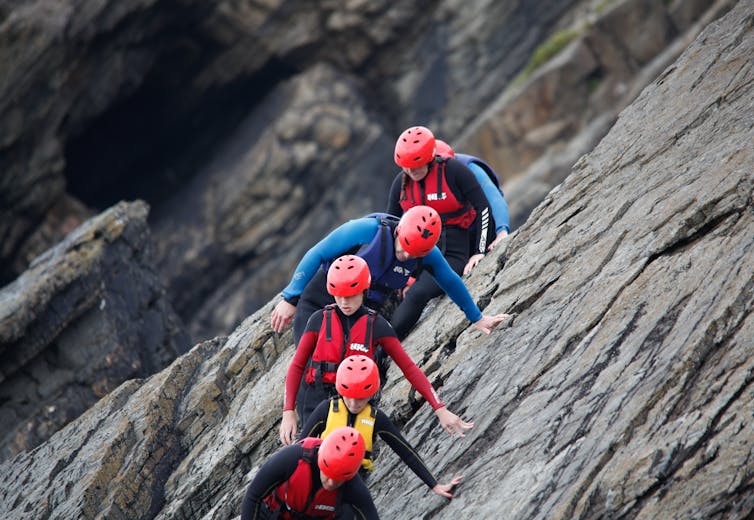
Research has found that school trips to face unanticipated challenges. They help pupils to mature, to form stronger bonds with peers and teachers, and become better students 鈥� all of which is vital for making the .
Beyond a child鈥檚 development, school trips bring social benefits too. A few days away together in a natural setting can be a great leveller. Classroom cliques and pressures dissipate when children 鈥� regardless of 鈥� have to work together to climb a mountain without a path or navigate the way through a gorge.
However, state funding to make this happen is crucial. The Institute for Outdoor Learning (a professional membership institute which champions learning in the outdoors) estimates that for the 1.4 million children who receive , going on a school trip might be the only opportunity they have to experience time away from home.
In on Natural Landscapes, the UK government highlighted how important it is that the British countryside remain accessible to everyone, including children from disadvantaged ethnic groups and low socio-economic backgrounds. This is all the more pressing during a pandemic which has heightened concerns around inequality of access to .
Despite the many demands on how school funds should be allocated and the commitment from staff that organising school trips requires, not to mention the decline in council-funded outdoor residential centres, demand for trips from schools . Teacher support for such trips at a time of immense pressure on education speaks volumes.
Finally, outdoor experiences can also help to foster and shape pro-environmental attitudes. Through residential school trips, UK pupils can discover areas they might not otherwise visit, and might perhaps, come to love and thereby wish to conserve and protect.
In 1978, American lepidopterist and ecologist Robert Pyle coined the term to capture the global phenomenon of a progressive loss of interactions with nature. It is a concept that applies to the closure of Rhos-Y-Gwaliau and other centres, and the resulting lack of opportunity for children to spend time there.
When leading British naturalist , 鈥淣o one will protect what they don鈥檛 care about; and no one will care about what they have never experienced,鈥� he voiced the concerns of many conservationists. Children are the future custodians of our planet and society. Ensuring that they have the chance to access nature 鈥� and enabling that through school trips 鈥� is something we must prioritise.
This article is republished from under a Creative Commons license. Read the .
Press Office | +44 (0)1962 827678 | press@winchester.ac.uk |
Back to media centre